
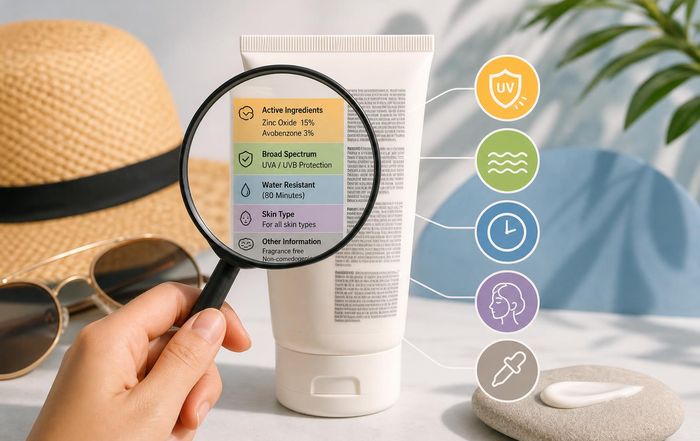
How to Read a Sunscreen Label Beyond the SPF Number
Most people reach for sunscreen by scanning for a familiar brand and a high SPF. Yet SPF is only one part of the story. To understand whether a product really protects your skin-and fits your routine-you need to know how to decode the rest of the label: from "broad spectrum" and PA ratings to water resistance claims, filters, and even the fine print.
This guide breaks down the key terms and symbols on sunscreen packaging, explains what they actually mean for your skin, and shows how to choose the right formula for everyday use, beach days, sports, and sensitive skin.
SPF: What It Really Tells You (and What It Doesn't)
SPF, or Sun Protection Factor, measures how well a sunscreen protects against UVB rays-the ones primarily responsible for sunburn and a major contributor to skin cancer. In simple terms, SPF is a ratio: it compares how long UVB exposure would take to cause redness on protected skin versus unprotected skin under standardized test conditions.
Dermatologists and organizations such as the American Academy of Dermatology recommend using at least SPF 30 for daily use, which blocks about 97% of UVB rays when applied correctly. SPF 50 blocks about 98%, and SPF 100 around 99%. The increase in protection becomes smaller as the number rises, which is why a very high SPF is not a magic shield. Many people also apply too little sunscreen and fail to reapply, so real-world protection is often much lower than the number suggests.
SPF also does not tell you how long you can stay in the sun without reapplying. Water, sweat, rubbing, and incomplete coverage all reduce effectiveness. Most regulators, including the U.S. Food and Drug Administration (FDA), emphasize that sunscreens must be reapplied at least every two hours and after swimming or sweating, regardless of SPF. SPF also says nothing about UVA protection; that requires other label cues, which are just as important for skin health and visible aging.
For readers who are building or upgrading their daily routine, pairing a suitable SPF with a consistent morning regimen can make a visible difference in texture, tone, and fine lines. Our broader skincare coverage explores how sunscreen fits alongside cleansers, serums, and moisturizers.
UVA vs. UVB: Why "Broad Spectrum" Matters
When reading a sunscreen label, one of the most important phrases to look for is "broad spectrum." This means the product has been tested and shown to protect against both UVB and UVA rays. UVB primarily causes sunburn, while UVA penetrates more deeply, accelerating photoaging and contributing to skin cancer. The World Health Organization notes that UVA is linked to premature skin aging and immune suppression in the skin, making UVA protection essential even on cloudy days and through windows.
In the United States, "broad spectrum" is a regulated claim overseen by the FDA's sunscreen monograph. To qualify, a product must meet specific UVA protection standards relative to its UVB protection. In the European Union and many other regions, regulators such as the European Commission expect UVA protection to be at least one-third of the labeled SPF, which is often indicated by a "UVA" logo encircled on the packaging.
In parts of Asia, particularly Japan and South Korea, UVA protection is often labeled using the PA system (PA+, PA++, PA+++, PA++++). This rating is based on Persistent Pigment Darkening (PPD) testing, which looks at how much UVA it takes to tan the skin. A PA++++ product offers high UVA protection, and many Asian sunscreens emphasize this alongside high SPF. For global shoppers, seeing both a high SPF and a strong PA rating can be a reassuring sign of balanced coverage.
If a sunscreen label lists a high SPF but does not say "broad spectrum," or lacks any reference to UVA or PA ratings in markets where those are standard, it may offer limited UVA protection. For anti-aging benefits and long-term skin health, that's a red flag. Readers particularly focused on visible signs of aging often combine broad-spectrum sunscreen with retinoids and antioxidants; our routines section looks at how to do that without causing irritation.
Decoding Different Rating Systems Around the World
Global beauty shoppers often encounter different symbols and rating systems on sunscreen labels, which can be confusing if you're used to one region's standards. In the U.S. and Canada, SPF plus the "broad spectrum" wording are the primary regulated cues. Additional labels like "water resistant (40 minutes)" or "water resistant (80 minutes)" are also strictly defined by FDA testing protocols; anything claiming to be "waterproof" or "sweatproof" is considered misleading and is not allowed.
In Europe, consumers may see the encircled UVA logo, which indicates compliance with the Colipa/ISO standard that UVA protection is at least one-third of the SPF. Some brands also voluntarily list a UVA-PF (protection factor) number, often based on PPD testing similar to the Asian PA system. Cancer Research UK and other organizations emphasize choosing broad-spectrum products with at least SPF 30 and adequate UVA protection for daily use.
In Japan, the Ministry of Health, Labour and Welfare regulates the PA system, while South Korea's Ministry of Food and Drug Safety oversees both SPF and PA claims. High-performing Korean and Japanese sunscreens often highlight PA++++ alongside terms like "UV essence" or "UV milk," which describe texture rather than protection level. Many of these formulas are popular globally because of their elegant, makeup-friendly finishes, especially for those who wear foundation or tinted moisturizers daily. Readers interested in how these innovations intersect with formulas and brands can explore our trends and brands and products coverage.
Understanding these systems helps when buying online from international retailers. While testing methods differ slightly, the core idea is consistent: look for products that clearly signal robust UVA as well as UVB protection, rather than relying on SPF alone.
Active Ingredients: Chemical vs. Mineral Filters
Beyond the numbers and symbols, the active ingredient list reveals how a sunscreen works. Most filters fall into two broad categories: organic (often called "chemical") filters that absorb UV and convert it to a small amount of heat, and inorganic (often called "mineral" or "physical") filters like zinc oxide and titanium dioxide that primarily scatter and reflect UV, though they also absorb some.
Common organic filters include avobenzone, octocrylene, octisalate, homosalate, and newer filters like Tinosorb S (bemotrizinol) and Uvinul A Plus (diethylamino hydroxybenzoyl hexyl benzoate). Many of the latest filters used in Europe and Asia offer strong UVA coverage with improved stability and cosmetic elegance, but they are not yet approved in the U.S. under the current FDA sunscreen regulations. This regulatory gap partly explains why some consumers in North America import sunscreens from other regions.
Mineral sunscreens rely mainly on zinc oxide and/or titanium dioxide, which are recognized as generally safe and effective by regulators such as the FDA and the European Chemicals Agency. They are often recommended for sensitive skin, children, and those prone to stinging or allergic reactions, as they are less likely to cause irritation. However, they can leave a white cast, especially on deeper skin tones, unless formulated with micronized or tinted pigments. There has been public discussion about nanoparticle forms of these minerals, but current reviews by bodies such as the European Commission's Scientific Committee on Consumer Safety have found them safe for use in sunscreens when formulated appropriately and not used in spray/powder forms that could be inhaled.
Choosing between chemical and mineral filters often comes down to skin type, sensitivity, and personal preference. Chemical filters tend to feel lighter and more invisible on the skin, making them easier for many people to wear under makeup or during exercise. Mineral filters can be excellent for reactive skin or post-procedure care but may require more blending and are sometimes better in tinted formats for an even finish. For readers balancing sunscreen with acne care or anti-aging actives, our beauty and makeup sections often highlight formulas that layer well without pilling or heaviness.
Water Resistance, Sweat, and Sport Claims
Labels like "water resistant," "very water resistant," or "sport" can be misleading if you don't know how they're regulated. In the U.S., "water resistant (40 minutes)" means the sunscreen maintained its SPF level during 40 minutes of water immersion under test conditions; "water resistant (80 minutes)" means 80 minutes. The FDA does not allow "waterproof" or "sweatproof" claims, as no sunscreen is completely impervious to removal by water or friction. Other regulators, such as the Therapeutic Goods Administration (TGA) in Australia, use similar time-based standards and strongly emphasize reapplication on high UV index days.
For beach days, water sports, or intense outdoor workouts, choosing a water-resistant sunscreen and reapplying generously is critical. Even with an 80-minute water-resistant formula, regulators and dermatology societies advise reapplying immediately after towel-drying, and at least every two hours while outdoors. "Sport" on a label is usually more of a marketing term than a regulated one; the key is to check for water resistance and a broad-spectrum SPF of 30 or higher.
Sweat and friction from clothing, hats, or equipment can also break down sunscreen, especially on high-movement areas like shoulders, neck, and nose. For people who exercise outdoors regularly, pairing a water-resistant sunscreen with physical barriers-such as UV-protective clothing, sunglasses, and hats-provides a more reliable shield than relying on sunscreen alone. Readers interested in integrating sun protection into active lifestyles may also find useful context in our health and fitness coverage, which frequently touches on outdoor training and skin safety.
Labels for Sensitive, Acne-Prone, or Reactive Skin
Many sunscreens now carry claims like "non-comedogenic," "for sensitive skin," "hypoallergenic," or "dermatologist tested." These phrases can be helpful starting points but are not tightly regulated in all markets, so they should be interpreted with some caution.
"Non-comedogenic" indicates that a product is formulated to be less likely to clog pores. However, standards vary by brand, and individuals with acne-prone skin may still react to certain emollients or filters. Oil-free, lightweight gels or fluids are often better tolerated, especially for those using retinoids or exfoliating acids. The American Academy of Dermatology suggests that people with acne-prone skin choose non-comedogenic, oil-free sunscreens and test new products on a small area first.
"For sensitive skin" and "hypoallergenic" typically mean the formula avoids certain common irritants such as fragrance, some preservatives, or particular filters that are more likely to cause reactions. Mineral sunscreens with zinc oxide and/or titanium dioxide are frequently recommended by dermatologists for sensitive or rosacea-prone skin, and some clinical guidance from organizations like the National Rosacea Society emphasizes fragrance-free, broad-spectrum options specifically.
If your skin is reactive, reading the full ingredient list is often more informative than marketing claims. Look for fragrance-free formulas, avoid alcohol-heavy sprays or gels if you are prone to dryness or stinging, and note any filters that have caused problems in the past. Patch testing on the inner arm or behind the ear for a few days can help identify potential issues before applying a new sunscreen to the entire face.
Texture, Finish, and How Sunscreen Fits with Makeup
Beyond protection, many people choose sunscreen based on how it feels and looks on the skin. Labels often describe texture and finish with terms like "gel," "milk," "lotion," "cream," "fluid," "matte," "dewy," or "tinted." These cues matter because a sunscreen you dislike using is one you're less likely to apply in the correct amount or reapply throughout the day.
Matte or oil-control sunscreens are often marketed to those with combination or oily skin. They may include mattifying powders or silica to reduce shine, making them popular as a primer under makeup. Dewy or moisturizing formulas typically contain emollients and humectants like glycerin or hyaluronic acid and may double as a daytime moisturizer, especially for normal to dry skin. Tinted sunscreens can help even out tone and reduce white cast, particularly in mineral formulas, and some also include iron oxides, which can offer additional protection against visible light and may be useful for conditions like melasma. Research summarized by the Journal of the American Academy of Dermatology has highlighted the role of visible light and pigmentation, which is why tinted, iron-oxide-containing sunscreens are increasingly recommended in certain hyperpigmentation cases.
If you wear foundation or BB cream, it's important not to rely solely on the SPF listed in your makeup. Studies and guidance from dermatology groups show that most people apply far less makeup than is used in SPF testing, which means the effective protection is much lower than the label suggests. Instead, apply a dedicated broad-spectrum sunscreen as the last step of your skincare routine, let it set, and then layer makeup on top. For those who want to reapply sunscreen over makeup, powder or spray formats can be useful, though their exact coverage is harder to control; they are best seen as a top-up, not a replacement for the initial application.
Our makeup and guides and tips sections often feature practical techniques for layering products without pilling, as well as product types that tend to sit well under foundation, concealer, or blush.
Understanding "Clean," Reef-Safe, and Environmental Claims
In recent years, sunscreen labels have begun to feature terms like "reef-safe," "reef-friendly," or "clean," often in response to consumer concerns about both personal health and environmental impact. However, many of these claims are not formally defined by regulators, and scientific understanding is still evolving.
Certain chemical filters, especially oxybenzone and octinoxate, have been restricted in places like Hawaii and parts of Palau due to concerns about their potential effects on coral reefs. Laws such as Hawaii's Sunscreen Law ban the sale of sunscreens containing these two ingredients, though the broader environmental impact of sunscreens compared to other stressors like climate change and pollution remains under active research. Many brands now market "reef-friendly" formulas that omit these filters, but there is no universal list of what qualifies, so the term should be interpreted cautiously.
"Clean" or "non-toxic" sunscreen is even less clearly defined. These labels usually reflect a brand's internal standards about which ingredients they choose to avoid, rather than a regulatory judgment. For consumers, it is more useful to focus on evidence-based safety assessments from regulators such as the FDA and the European Commission, which regularly review the safety of UV filters, than to rely on broad marketing descriptors.
If environmental impact is a priority, consider a combination of approaches: choose sunscreens without filters that are restricted in your region, opt for mineral formulas if you prefer, and reduce overall reliance on topical products by using UPF clothing, hats, and shade when possible. For those thinking about beauty through a sustainability lens, our technology beauty and trends coverage frequently explores how brands are reformulating and updating packaging in response to environmental research.
How Much to Apply and How Often: Reading Between the Lines
Even the best-labeled sunscreen will underperform if not used correctly. While labels may mention "generous application," they rarely explain what that means in practical terms. Most testing standards are based on applying 2 mg of sunscreen per square centimeter of skin, which translates roughly to about a quarter to half a teaspoon for the face and neck, and about one shot-glass (30 ml) for the body of an average adult.
Public health organizations such as the Skin Cancer Foundation recommend reapplying every two hours, or more often after swimming, sweating, or towel-drying, regardless of SPF or water resistance claims. For everyday urban routines with limited outdoor exposure, some dermatologists suggest that one generous morning application may be acceptable if you are mostly indoors and not sweating, but any substantial sun exposure-commutes, lunch outdoors, errands, or workouts-calls for more frequent reapplication.
Because labels often assume ideal conditions, it helps to mentally adjust their promises to real life. Rubbing, touching the face, blowing your nose, or wearing masks and hats can remove sunscreen from key areas like the nose, cheeks, and forehead. Carrying a travel-size product in your bag, keeping one at your desk, or using a compact or stick for touch-ups can make it easier to stay protected throughout the day.
Putting It All Together When You Shop
Reading a sunscreen label beyond the SPF number means looking at the entire package as a set of clues about how the product will perform for you. A practical way to approach it is to prioritize a few non-negotiables, then fine-tune based on your skin type and lifestyle.
For most people, the essentials are: broad-spectrum protection with at least SPF 30; clear UVA protection signaling (such as "broad spectrum," a UVA logo, or a strong PA rating); a texture you will actually use in sufficient quantity; and a formula that suits your skin's needs, whether that means non-comedogenic, fragrance-free, mineral, or water-resistant. Beyond that, consider when and where you will wear it most-at a desk, on a running trail, or in the ocean-and choose finishes and formats that fit those contexts.
Sunscreen is not a standalone fix, but it is the backbone of any effective skincare routine aimed at maintaining healthy, even-toned, and resilient skin over time. Understanding the language of labels makes it easier to choose wisely, avoid disappointment, and build habits you can sustain. From there, you can layer in the rest of your routine-cleansers, serums, treatments, and makeup-confident that the first and most important line of defense is in place.
