
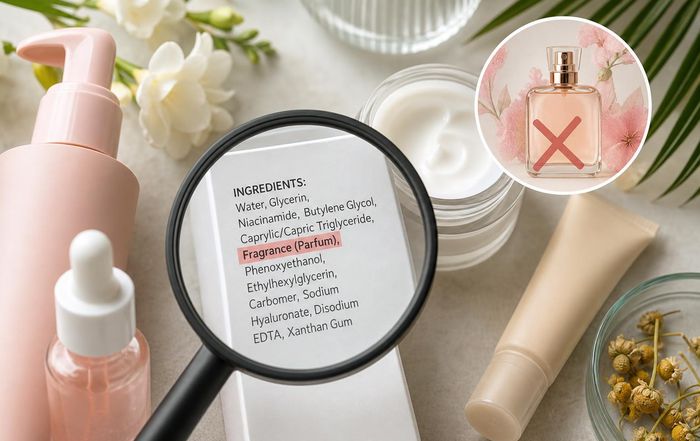
How to Spot Irritating Fragrance in Skincare Labels
Fragrance is one of the most common reasons otherwise promising skincare causes stinging, redness, or breakouts. Yet on the label, it often hides behind vague terms and long chemical names. Understanding how to identify potentially irritating fragrance ingredients can make the difference between a calm, healthy complexion and a constant cycle of reactions. Today we will know how fragrance is regulated and listed, which terms to watch for, and how to navigate labels if you have sensitive or reactive skin.
Why fragrance is a problem for many skin types
Dermatology research consistently identifies fragrance as a leading cause of cosmetic contact dermatitis. The American Academy of Dermatology notes that fragrance is among the most frequent allergens in skincare and personal care products, especially in leave-on formulas such as moisturizers and serums. For people with conditions like eczema, rosacea, or a compromised skin barrier, fragrance can trigger burning, itching, or delayed rashes even when the product feels fine on first use.
Fragrance-related irritation can be either irritant or allergic. Irritant reactions usually appear quickly and are caused by the ingredient's inherent harshness, while allergic reactions involve the immune system and may develop after repeated exposure. According to the North American Contact Dermatitis Group, fragrance mix (a standardized test blend of common fragrance allergens) is one of the most frequent positive patch-test allergens in patients with suspected cosmetic reactions. Importantly, even products labeled "for sensitive skin" may contain fragrance ingredients that are irritating for some users, which is why reading the full ingredient list matters more than marketing claims on the front of the packaging.
For readers who are already dealing with sensitivity, it can be helpful to combine fragrance awareness with a gentle, barrier-supportive routine. Our skincare section covers broader topics such as skin barrier repair and soothing routines, which complement the label-reading skills discussed here.
How fragrance is regulated and listed on labels
Before decoding specific ingredient names, it helps to understand how fragrance is regulated and why it often appears as a catch-all term. In many markets, including the United States and much of the European Union, companies are allowed to group complex fragrance mixtures under umbrella terms like "fragrance," "parfum," or "aroma" to protect proprietary formulas. The U.S. Food and Drug Administration (FDA) explains that "fragrance" can represent dozens or even hundreds of individual components, many of which are not individually disclosed on the label.
In the EU and the UK, regulations are somewhat stricter for known fragrance allergens. Under the EU Cosmetics Regulation, if certain fragrance allergens exceed specific concentration thresholds in a product, they must be listed individually on the ingredient list. These are often referred to as the "26 fragrance allergens," and include substances such as limonene, linalool, citronellol, and eugenol. The European Commission provides detailed technical information on these allergens, and some additional fragrance substances are being considered for expanded disclosure based on newer safety assessments.
Despite these rules, brands still have flexibility in how they present fragrance information. A label might list "parfum" plus several allergen names, or simply "fragrance (parfum)" without further detail if allergen levels are low enough. Some brands voluntarily disclose more detail, especially those targeting sensitive skin or "clean" beauty audiences. However, the absence of listed allergens does not always mean the product is fragrance-free; it may simply mean that individual allergen concentrations fall below regulatory thresholds.
The obvious red flags: "Fragrance," "Parfum," and "Aroma"
The simplest way to identify added scent is to look for the words "fragrance," "parfum," or "aroma" on the ingredient list. These terms almost always indicate a mixture of fragrance compounds, which can be synthetic, natural, or a blend of both. From a skin-sensitivity perspective, "natural" is not automatically safer: essential oils and plant extracts often contain potent fragrance molecules that can be just as irritating, or more so, than their synthetic counterparts.
When "fragrance" or "parfum" appears high on the ingredient list (closer to the beginning), it usually indicates a higher concentration relative to other ingredients, which may be more problematic for very reactive skin. That said, even small amounts can trigger allergy in sensitized individuals. The American Contact Dermatitis Society emphasizes that fragrance allergy is dose-independent for many people, meaning once you are sensitized, even minimal exposure can provoke symptoms.
If your skin is easily irritated, many dermatologists recommend avoiding leave-on products that list "fragrance," "parfum," or "aroma" altogether, especially in categories like moisturizers, eye creams, and serums. You may still decide to accept fragrance in rinse-off products such as body wash or shampoo, but it is worth monitoring your skin to see whether even short contact causes redness or itching. For readers building a more minimal routine, our guides and tips section offers additional advice on simplifying product choices.
The less obvious culprits: common fragrance allergens to recognize
Beyond the generic "fragrance" label, many individual fragrance chemicals are known to cause irritation or allergy, particularly in people with a history of sensitive skin. In the EU and UK, several of these must be declared when present above low thresholds. Learning to recognize these names can help you spot potentially problematic products even when they are not marketed as fragranced.
Some of the more frequently encountered fragrance allergens include limonene, linalool, citronellol, geraniol, eugenol, coumarin, citral, hydroxycitronellal, cinnamal (cinnamaldehyde), and farnesol. These substances often come from essential oils such as citrus, rose, lavender, or cinnamon, but they may also be produced synthetically. The Scientific Committee on Consumer Safety (SCCS), which advises the European Commission, has published opinions on several of these compounds, noting that they can cause contact allergy in a significant portion of the population.
It is also important to understand that some of these allergens become more sensitizing when they oxidize in air. For example, limonene and linalool can form more allergenic oxidation products when exposed to light and oxygen over time, which is one reason older, opened products may suddenly start to irritate even if they were previously tolerated. The Journal of the European Academy of Dermatology and Venereology has published research on oxidized fragrance terpenes and their role in contact allergy, highlighting the importance of product freshness and proper storage.
If you see several of these allergens listed in a product, it often indicates a more complex or intense fragrance profile. For highly reactive skin, especially in facial care, it can be safer to avoid such formulations entirely and focus on simpler products, many of which are highlighted in fragrance-free routines discussed in our skincare and routines sections.
The "natural" trap: essential oils and botanical fragrance
Many products marketed as "clean," "green," or "natural" avoid synthetic fragrance but rely heavily on essential oils and aromatic plant extracts for scent. While these can be appealing, they are not automatically gentle. Essential oils are highly concentrated mixtures of volatile compounds, many of which are recognized fragrance allergens. The National Eczema Association and various dermatology groups caution that essential oils such as tea tree, peppermint, lavender, citrus oils (like lemon, orange, bergamot), and ylang-ylang are common triggers for irritation and allergy.
On labels, essential oils may appear under their Latin botanical names (for example, Citrus limon peel oil, Lavandula angustifolia oil, Mentha piperita oil) or more familiar English names (lemon oil, lavender oil, peppermint oil). They may also be part of broader plant extracts used "for scent" even if the label highlights other purported benefits. For someone with robust skin, low levels of certain essential oils may be tolerable, but for those with eczema-prone or rosacea-prone skin, repeated exposure can worsen flushing, burning, or dryness.
Complicating matters further, some essential oils are photosensitizing, meaning they can increase the skin's sensitivity to UV light and raise the risk of sunburn or pigmentation when applied before sun exposure. Citrus oils such as bergamot and expressed lime oil are notable examples; the International Fragrance Association (IFRA) issues specific use restrictions and safety standards for many of these. For facial skincare, especially daytime products, fragrance-free formulas are generally a safer option than those scented predominantly with essential oils.
Readers exploring more holistic or wellness-driven beauty may find it useful to distinguish between aromatherapy products designed for short, controlled use and daily leave-on skincare for the face. The latter typically requires more caution with fragrant botanicals, which we also emphasize in our wellness and beauty coverage.
"Unscented" vs "fragrance-free": why the wording matters
Labeling terms like "unscented" and "fragrance-free" can be confusing and, in some cases, misleading. In many markets, "fragrance-free" is generally understood to mean that no fragrance materials have been added for the purpose of scenting the product. However, it may still contain ingredients that have a mild natural odor, such as certain plant oils or actives, as long as no extra fragrance blend has been included. Some regulators and industry groups, including the FDA, note that "fragrance-free" is not a strictly defined legal term, so practices can vary by brand.
"Unscented," on the other hand, often means that the product does not have an obvious smell-but it may achieve that by using masking fragrances that neutralize or cover the odor of other ingredients. In other words, "unscented" products can still contain fragrance compounds, which may be listed on the ingredient list as "fragrance," "parfum," or specific allergen names. For someone with fragrance sensitivity, "unscented" is therefore not a reliable indicator of safety.
Because terminology is inconsistent, the most reliable approach is to ignore front-of-pack claims and go straight to the full ingredient list. If you see "fragrance," "parfum," "aroma," or several known fragrance allergens, then the product is not truly free of fragrance exposure, regardless of how it is described in marketing. For people with diagnosed fragrance allergy, dermatologists often recommend looking for products explicitly labeled "fragrance-free" and confirming the absence of fragrance-related terms on the INCI list.
Where fragrance is most risky: leave-on vs rinse-off products
Not all fragranced products pose equal risk. Leave-on products-such as moisturizers, serums, facial oils, eye creams, and leave-in hair treatments-stay on the skin for many hours, increasing the chance of irritation or allergy. Facial skin, eyelids, neck, and areas with a compromised barrier (for example, eczema patches) are especially vulnerable. For these categories, many dermatologists, including experts quoted by the American Academy of Dermatology, recommend fragrance-free options whenever possible, particularly for sensitive or reactive skin.
Rinse-off products like cleansers, body washes, shampoos, and conditioners are in contact with the skin for a shorter time, and some people tolerate fragrance in these better. However, those with severe fragrance allergy or chronic eczema may still react even to short exposure, especially if the product is heavily scented or used frequently. Patchy body rashes or worsening hand dermatitis can sometimes be traced back to fragranced soaps or shower gels. In these cases, switching to fragrance-free versions can be a helpful part of a broader health and fitness and skin-care strategy.
Another category to treat cautiously is products used on compromised skin, such as after procedures (chemical peels, microneedling, laser) or on broken or inflamed areas. Post-procedure instructions from dermatology clinics and sources like the American Society for Dermatologic Surgery typically advise avoiding fragranced products until the skin has fully healed, as fragrance can sting intensely and delay recovery.
Practical steps to read labels and reduce your risk
Learning to spot irritating fragrance on skincare labels becomes easier with practice. A practical approach often starts with scanning for the broad terms-"fragrance," "parfum," "aroma"-and then checking for common allergen names and essential oils. If your goal is to minimize risk, especially on the face, you may choose products that contain none of these, focusing instead on formulas that rely on non-fragrant emollients, humectants, and barrier-supporting ingredients.
Patch testing new products is a simple but underused tool. Dermatologists and organizations like the National Eczema Association recommend applying a small amount of the new product to the inner forearm or behind the ear once or twice daily for several days, watching for redness, itching, or bumps. While this at-home method is not as precise as formal patch testing in a clinic, it can help catch obvious irritants before applying them widely on the face. Those with persistent or severe reactions may benefit from professional patch testing guided by an allergist or dermatologist, which can identify specific fragrance mix or individual allergens to avoid.
Keeping your routine relatively streamlined also reduces cumulative exposure. Using many fragranced products together-cleanser, toner, serum, moisturizer, sunscreen, and makeup-adds up, even if each one contains only a small amount of fragrance. Simplifying to a few carefully chosen staples, as often discussed in our routines and makeup coverage, can make it easier to pinpoint what your skin tolerates and to maintain long-term comfort.
When it's worth seeking professional guidance
If you consistently react to skincare despite choosing gentle, fragrance-light products, or if you have a history of eczema, asthma, or other allergies, professional input can be valuable. Dermatologists and allergists can use standardized patch-test panels, including fragrance mix and common fragrance allergens, to pinpoint which substances you should avoid. The European Society of Contact Dermatitis and national dermatology societies publish guidelines that help clinicians interpret these tests and advise patients on safe product selection.
Professional advice is especially important if reactions involve swelling around the eyes or lips, widespread rashes, or any sign of breathing difficulty, which can indicate more serious allergy. While many fragrance reactions are limited to local irritation or dermatitis, underestimating symptoms can prolong discomfort and make daily life more difficult than it needs to be. Bringing photos of reactions and a list-or even physical examples-of products you use can help clinicians identify patterns more quickly.
Once specific allergens are identified, patients are often given written lists of names and synonyms to watch for on labels. This can initially feel overwhelming, but over time, most people become adept at scanning for their personal triggers. Combining these lists with a preference for fragrance-free or minimally formulated products generally leads to a more comfortable and predictable relationship with skincare.
Bringing it all together
Fragrance makes skincare pleasant to use, but it is also one of the most common sources of irritation and allergy. Learning to read labels with a critical eye-looking beyond "unscented" claims, recognizing the catch-all terms "fragrance," "parfum," and "aroma," and spotting individual allergens and essential oils-gives consumers much greater control over how their skin feels day to day.
For some, avoiding fragrance in leave-on facial products and around sensitive areas will be enough. Others, particularly those with eczema or documented fragrance allergy, may need to be stricter across all categories, including body care and haircare. In all cases, pairing label literacy with patch testing, simple routines, and, when needed, professional guidance helps reduce trial-and-error and makes it easier to enjoy skincare without fear of flare-ups.
Happy readers interested in building a gentle, fragrance-aware routine can explore related news across our skincare, beauty, guides and tips, brands and products, and trends sections, where ingredient transparency and skin comfort remain central themes.
