
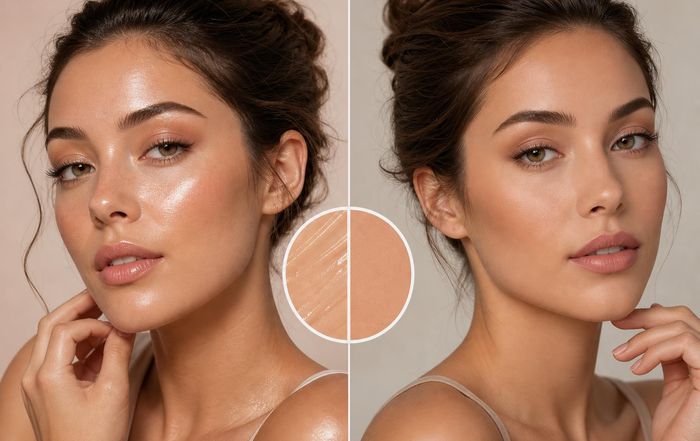
Dewy vs. Satin Makeup Finishes: What's the Real Difference?
Makeup finish shapes how skin looks in real life and in photos just as much as coverage or color. Two of the most requested looks today are "dewy" and "satin," but the terms are often used loosely, even by brands. Understanding how they differ helps in choosing the right foundation, highlighter, or setting products for your skin type, climate, and personal style.
This guide breaks down what each finish actually looks like, how they're created in formulas, who they suit best, and how to achieve or adjust each effect with the products you already own.
For more fundamentals on complexion products, readers can explore related coverage in our makeup and beauty sections.
What "Finish" Really Means in Makeup
In complexion products, "finish" describes how the product reflects light once it has set on the skin. It's separate from coverage (sheer, medium, full) and from shade, although those all work together to create the final look.
Cosmetic chemists adjust finish using a balance of:
Oils and emollients, which give slip and shine.
Humectants such as glycerin or hyaluronic acid, which attract water and create a plump, moist look.
Silicones, which create a smoother, more diffused surface and can either look luminous or more velvety depending on the blend.
Powders and pigments, including traditional talc and newer silica or polymer spheres that scatter light and reduce shine.
Pearlescent or reflective particles, which add visible glow or sheen.
Organizations such as the Personal Care Products Council and cosmetic science groups like the Society of Cosmetic Chemists regularly publish technical discussions on how different raw materials influence optical effects, underlining that finish is largely about light behavior on the skin surface.
Within that framework, "dewy" and "satin" describe two different ways of handling light and texture.
How a Dewy Finish Looks and Feels
A dewy finish aims to mimic the look of very well-moisturized, freshly treated skin. It is visibly radiant, with a sheen that catches light on the high points of the face. Think of the subtle glow seen in many K-beauty campaigns or the "glass skin" trend: the skin appears hydrated, smooth, and almost damp, but not greasy.
Dewy products typically contain a higher proportion of emollients and humectants, and often fewer mattifying powders. Ingredients such as squalane, plant oils, glycerin, and hyaluronic acid are common, sometimes supported by skin-care actives like niacinamide or ceramides. According to overviews from the American Academy of Dermatology (AAD) and Harvard Health Publishing on moisturizers and barrier repair, these components are known to support hydration and surface smoothness, which helps the light-reflective effect look more natural rather than oily.
On the skin, dewy foundations and tinted moisturizers feel emollient and flexible. They rarely dry down completely and may remain slightly tacky, which can be comfortable for dry or mature skin but less so for those who dislike any sense of residue. Dewy finishes also tend to have a more noticeable "glow" in photos and under indoor lighting, which many people find flattering for evening or editorial looks.
How a Satin Finish Looks and Feels
A satin finish sits between matte and dewy. It is designed to resemble healthy, balanced skin: not overtly shiny, but not flat or powdery. In natural light, a satin base reflects some light from the high points of the face, but the overall impression is smoother and more controlled than a true dewy formula.
To achieve this, satin products usually combine moderate emollients and humectants with a measured amount of soft-focus powders or silicone elastomers. These ingredients blur pores and texture while still allowing some luminosity to come through. Cosmetic science literature, including work summarized by the International Federation of Societies of Cosmetic Chemists, often describes this as creating a "semi-matte" or "natural" optical profile.
On the skin, satin finishes typically:
Feel lighter and drier to the touch than dewy formulas once set.
Resist transfer better, especially when paired with a light dusting of powder.
Work well under flash photography and bright daylight because there are fewer hotspots of shine.
Many brands market satin-finish bases as "natural," "skin-like," or "radiant matte," which can add to the confusion. In most cases, if the product promises a natural look with soft radiance but also claims some oil control, it is closer to satin than dewy.
Key Differences at a Glance
Although both finishes aim for healthy-looking skin, they diverge in several practical ways.
A dewy finish:
Has a noticeable sheen across larger areas of the face.
Emphasizes hydration and glow, sometimes at the expense of longevity on oily areas.
Often feels slightly emollient or tacky even after setting.
Can make dry or textured skin look more supple if the underlying skincare is well-chosen.
May emphasize large pores or uneven texture on very oily or acne-prone skin, especially in the T-zone.
A satin finish:
Looks more softly luminous and controlled, with glow mainly on high points.
Balances a natural radiance with some oil-absorbing or blurring properties.
Usually sets more fully, feeling smoother and less sticky to the touch.
Tends to be more forgiving across a wider range of skin types and climates.
Can be easier to maintain through a long workday or event without frequent touch-ups.
Dermatology-aligned resources such as the Cleveland Clinic's guidance on oily skin and Mayo Clinic's overview of dry skin reinforce that oil production, climate, and barrier health strongly influence how these finishes will appear and wear.
Matching Finish to Skin Type and Concerns
Choosing between dewy and satin is not just an aesthetic decision; it is also about how the skin behaves over the day.
For dry or dehydrated skin, a dewy finish can complement the skin's needs if the base is supported by a well-formulated moisturizer and, ideally, a hydrating primer. The glow can make fine lines and flakiness less visible by filling in surface irregularities with emollients. However, if the skin is very rough or peeling, a high-shine finish may actually highlight uneven patches. Thorough, gentle exfoliation and barrier-supporting skincare, as recommended by the AAD, become essential before applying a dewy base.
For normal or combination skin, satin finishes are often the most versatile choice. They can accommodate mild T-zone oiliness while still looking fresh on drier cheeks. A combination approach also works well: a satin foundation applied all over, with subtle liquid or cream highlighter added to the high points of the face to mimic dew only where it is most flattering. Readers interested in building such routines can find more ideas in our routines and guides and tips coverage.
For oily or acne-prone skin, a fully dewy finish can be challenging, particularly in hot or humid climates. Excess shine tends to pool in areas with more sebaceous glands, and research summarized by the Journal of the American Academy of Dermatology suggests that sebum, texture, and enlarged pores often cluster together. In such cases, a satin or even soft-matte base with targeted, controlled highlighting typically looks more polished and wears longer. Oil-free, non-comedogenic formulas, and thoughtful use of powder in the T-zone, can help balance the desire for glow with the need for durability.
For mature skin, the choice is nuanced. Dewy finishes can make skin look more youthful and less lined by simulating the plumpness that naturally declines with age, especially when paired with skincare rich in humectants and barrier lipids. However, too much shine can accentuate deeper lines or settled product. Satin is often a safer baseline, with a hint of cream highlighter where skin is smoothest, such as the tops of the cheekbones. The British Association of Dermatologists notes that age-related changes in texture and elasticity alter how light reflects from the skin, which is why finish choice can be particularly important in later decades.
How Climate and Lifestyle Change the Equation
Finish is also deeply influenced by environment. In humid climates, even a satin foundation can become dewy as natural oils mix with moisture and body heat. Conversely, in cold, dry air or heated indoor environments, a dewy base can lose its glow quickly if the underlying skin is dehydrated, sometimes breaking apart around fine lines or dry patches.
For those living in very humid regions or spending long hours outdoors, a satin or soft-matte base with a hydrating skincare routine can be more practical than a fully dewy product. Sweat and sebum can quickly push a dewy finish into greasy territory, especially on the T-zone. Resources from the American Academy of Dermatology on summer skin care emphasize the role of lightweight, non-comedogenic sunscreens and oil control, which pair more easily with satin or semi-matte complexion products.
Office or studio lighting is another consideration. Under bright artificial lights, dewy formulas can create strong hotspots on the forehead, nose, and chin. That can be beautiful in editorial photography when carefully placed, but less forgiving in everyday situations. Satin finishes tend to photograph more predictably across different lighting conditions, which is why they are often favored for events, bridal makeup, or professional settings.
Building a Dewy Look Step by Step
Creating a dewy finish is as much about preparation as it is about foundation choice. The effect looks most convincing on skin that is well hydrated and relatively smooth. Many K-beauty-inspired routines, like the "glass skin" trend highlighted by outlets such as Allure, focus on layered hydration, gentle exfoliation, and barrier support to lay the groundwork.
A typical dewy-leaning routine might include:
A hydrating, non-stripping cleanser.
An essence or lightweight serum with humectants such as glycerin or hyaluronic acid.
A moisturizer with emollients and occlusives appropriate for the climate.
A glow-enhancing or hydrating primer.
A luminous or hydrating foundation or tinted moisturizer.
Cream or liquid blush, bronzer, and highlighter, which blend more seamlessly into a dewy base than powders.
Powder is used sparingly, if at all, and usually only in areas where creasing or excess shine would be distracting, such as around the nose or under the eyes. For more detailed skincare-first approaches, readers may find useful context in the site's skincare and wellness sections.
Building a Satin Look Step by Step
A satin finish often starts from the same skin-care base but introduces more control with primers and setting products. The skin is still prepped to be hydrated, but not overly emollient, so that the foundation can set properly.
A satin-oriented routine might look like:
A gentle cleanser and targeted treatment products suited to skin type.
A moisturizer that fully absorbs without leaving heavy residue.
A smoothing or blurring primer, often silicone-based, to even out texture and control shine in specific areas.
A foundation labeled "natural," "satin," or "semi-matte," applied in thin layers.
Selective use of translucent or soft-focus setting powder, especially on the T-zone.
Powder or cream cheek products, depending on preference, with a subtle highlighter if desired.
Because satin finishes tend to be more forgiving, they pair well with a wide range of color products and can be adapted for day or night with relatively minor tweaks. Those interested in product-by-product breakdowns can explore additional coverage in our brands and products and trends sections.
How to Tell if a Product Is Dewy or Satin When Labels Are Vague
Marketing language can be inconsistent, and many complexion products avoid strict finish labels altogether. When in doubt, several strategies help decode the likely result:
Check the claims and keywords. Phrases like "radiant," "glow," "luminous," "fresh," or "dewy" usually indicate a dewy or luminous finish. Words like "natural," "skin-like," or "soft matte" often point to satin. Strong claims about "oil control," "shine-free," or "long-wear matte" usually move away from dewy.
Scan the ingredient list. A high concentration of humectants and emollients, and fewer silica or starch-based powders, suggests a more dewy finish. Conversely, a visible presence of silica, starches, or polymer spheres often supports a satin or matte result. The INCI Decoder and similar resources can help consumers interpret ingredient lists, though they should be used as informational tools rather than absolute predictors.
Look at swatches in different lighting. Many major retailers and brands now offer high-resolution swatches and video demonstrations. Observing how the product behaves on moving skin, especially on the forehead and cheeks, is often more informative than still images alone.
Read independent reviews. Established beauty publications such as Into The Gloss, Refinery29 Beauty, or Byrdie regularly test and describe foundation finishes, which can help bridge the gap between marketing language and real-world performance.
Adjusting Finish Without Replacing Your Entire Routine
One advantage of understanding finish is that it becomes easier to tweak the look of existing products rather than constantly buying new ones. Many makeup artists and cosmetic chemists point out that finish is somewhat flexible once you know which steps to alter.
To make a dewy foundation look more satin:
Apply a more matte or oil-controlling primer on the T-zone.
Use a damp sponge to press and blend the product thinly, focusing coverage only where needed.
Set selectively with a finely milled translucent powder, concentrating on areas that tend to crease or shine.
Blot gently with blotting papers or a tissue during the day rather than adding more product.
To make a satin or semi-matte foundation look more dewy:
Prep the skin with a hydrating serum or lightweight facial oil (if compatible with your skin type) before foundation.
Mix a drop of liquid highlighter or luminizing primer into the foundation on the back of the hand.
Use cream blush and highlighter on the high points of the face instead of all powder products.
Finish with a hydrating or glow-enhancing setting spray rather than a mattifying one.
These adjustments allow the same base product to serve different occasions: more controlled and long-wearing for workdays, more luminous and relaxed for evenings or weekends. Readers who enjoy experimenting with these techniques may also be interested in broader coverage in the site's fashion and health and fitness sections, where overall lifestyle and presentation are often discussed together.
When to Choose Dewy, When to Choose Satin
The choice between dewy and satin finishes ultimately comes down to context and personal preference rather than strict rules. However, a few guidelines can help:
Dewy is often ideal for low-key days, dry or dull-looking skin, editorial or creative looks, and situations where a fresh, youthful glow is the priority over maximum longevity or oil control.
Satin is generally better for mixed or unpredictable skin days, long events, professional settings, or occasions when flash photography and varied lighting are likely.
Dermatology and cosmetic science sources agree that the base skincare routine-cleansing, moisturizing, sun protection-is more important for skin health than any makeup finish. The finish chosen sits on top of that foundation, shaping the visual impression rather than the underlying condition. Resources from the U.S. Food and Drug Administration's cosmetics section and the European Commission's Cosmetic Products database can help consumers understand how these products are regulated and what claims actually mean.
Understanding how dewy and satin finishes differ, and how to adapt them, makes it easier to treat makeup as a flexible tool rather than a fixed identity. With a little experimentation, most people can find a version of each finish that works for their skin, climate, and lifestyle, switching between them as effortlessly as changing a lipstick shade.
