
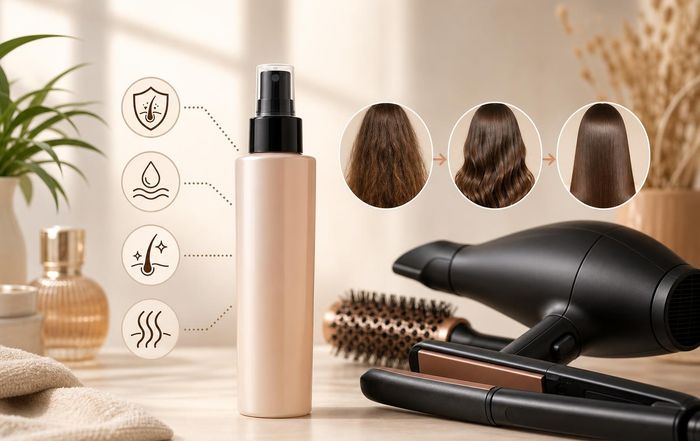
A Practical Guide to Choosing a Heat Protectant for Hair
Heat styling makes it easier to shape hair into sleek, polished looks, but it also exposes strands to temperatures that can weaken, dry, and break them over time. A good heat protectant will not make hair invincible, yet it can significantly reduce damage and help preserve shine, color, and elasticity. With sprays, creams, serums, and mists all promising "protection up to 450°F," it can be difficult to know what actually matters.
This guide breaks down how heat damage happens, what ingredients really help, how to match a product to your hair type and styling routine, and how to apply it properly so you get the most protection without a heavy, greasy feel.
For broader hair-care context, readers who are also rethinking their overall routine may find it useful to explore our sections on skincare, beauty, routines, and guides and tips.
What heat actually does to your hair
To choose a heat protectant well, it helps to understand what it is up against. Hair is mostly made of keratin, a protein organized into complex structures held together by different types of bonds. According to dermatology research summarized by the American Academy of Dermatology (AAD), high temperatures can temporarily or permanently alter those bonds. At around 150-185°C (300-365°F), common flat-iron temperatures, the cuticle (the outer protective layer) begins to crack and lift, and repeated exposure can cause internal fractures in the cortex, leading to breakage and loss of elasticity.
Water in and on the hair is another factor. When hair is very wet and exposed to intense heat, the rapid conversion of water to steam can create "bubble hair" damage inside the shaft, which weakens it from within. A study published in the Journal of Cosmetic Science has shown that hair blow-dried at moderate temperatures with some airflow distance suffers less structural damage than hair that is air-dried and then aggressively flat-ironed while still slightly damp. This is one reason many stylists recommend thoroughly drying hair before using high-heat tools and not passing an iron repeatedly over the same section.
Heat can also accelerate color fade, particularly in chemically treated hair. The Skin Cancer Foundation notes that UV exposure compounds this by degrading both pigment and protein in the hair shaft, which is why color-safe routines often include both heat and UV protection. Over time, the combination of hot tools, UV, and chemical services can lead to rough texture, frizz, split ends, and a dull, porous surface that struggles to hold moisture or color.
How heat protectants work (and what they can't do)
Heat protectants are not a literal shield that makes hair immune to damage, but they can reduce the amount of harm in several ways. Many formulas use film-forming ingredients that coat the hair shaft with a thin layer, helping distribute heat more evenly along the strand and slowing down heat transfer. This can help avoid hot spots where a tool lingers or clamps more tightly. Silicones such as dimethicone, amodimethicone, and cyclopentasiloxane are common here, as are certain polymers that create lightweight films.
Some protectants also help manage the hair's moisture content, which is critical because hair that is either too wet or too dry is more vulnerable to heat. Conditioning agents like quaternary ammonium compounds ("quats"), panthenol, and certain oils can help maintain flexibility and reduce friction between strands. According to information from the Society of Cosmetic Chemists (SCC), this reduction in friction can lower mechanical damage from brushing and styling, which often accompanies heat damage.
A newer category of ingredients includes protein-based or bond-supporting complexes that claim to reinforce internal hair structure. Brands inspired by bond-building chemistry, which has been discussed in outlets such as the Journal of Cosmetic Dermatology, typically use small molecules that interact with keratin or help mitigate the effects of chemical services. While these ingredients can improve feel and strength over time, they still do not mean that daily 450°F heat styling will be consequence-free.
It is also important to understand limitations. No spray or serum can fully offset extremely high temperatures, repeated passes of a flat iron on one section, or chronic overuse of hot tools. The British Association of Dermatologists notes that the safest approach is a combination of moderate tool temperatures, less frequent heat styling, and protective products rather than relying on products alone (BAD hair care guidance). A heat protectant should be seen as part of a healthier styling routine, not as permission to ignore tool settings or frequency.
Key ingredients to look for (and a few to treat with care)
Most effective heat protectants share several categories of ingredients, though the exact combination and texture will vary. Understanding these groups helps consumers read labels more confidently instead of relying purely on marketing claims.
Silicones are among the most studied heat-protective agents. Ingredients like dimethicone, amodimethicone, and phenyl trimethicone form smooth films that improve slip and reduce friction while also moderating heat transfer. A technical paper from Dow and other silicone manufacturers (aimed at formulators) has shown that certain silicone blends can measurably reduce cuticle cracking and color fade in treated hair when used before thermal styling. Silicones are not inherently bad for hair; the concern is mainly about buildup if they are used heavily without adequate cleansing. For those who prefer to limit them, occasional clarifying shampoos can manage residue.
Film-forming polymers such as polyquaternium-55, VP/DMAPA acrylates copolymer, and PVP/VA copolymer can also create protective layers. These are common in blow-dry sprays and flexible-hold products. They often help hair resist humidity and frizz, which indirectly protects by reducing the need to restyle with heat throughout the day. The Personal Care Products Council notes that these polymers are widely used and generally considered safe in rinse-off and leave-on hair products at normal usage levels.
Conditioning agents and lightweight emollients help maintain pliability under heat. These include panthenol (pro-vitamin B5), cetrimonium chloride, behentrimonium chloride, and oils like argan, grape seed, and sunflower. According to Cosmetics & Toiletries magazine, some saturated and monounsaturated oils penetrate the hair shaft partially, while others mostly coat the surface. Both can be helpful, but heavy, slow-spreading oils may feel greasy or weigh down fine hair when used in leave-in protectants.
There are also specialized ingredients with more targeted claims. Hydrolyzed proteins (such as hydrolyzed wheat, silk, or keratin) can temporarily patch weak spots along the cuticle, improving smoothness and combability. Some products include antioxidants like vitamin E or green tea extract to help counter oxidation triggered by heat and UV, an approach supported by studies on oxidative hair damage published in International Journal of Cosmetic Science. A few heat protectants add UV filters like benzophenone-4 or ethylhexyl methoxycinnamate; while these are more commonly associated with skin sunscreens, they can help slow color fade in hair when used in styling products.
Ingredients to treat with nuance include high levels of drying alcohols (such as SD alcohol 40 or denatured alcohol) in very fine mists. These can help products dry quickly and feel weightless, which is welcome for fine or oily hair, but in very dry or highly porous hair they may contribute to further dryness if not balanced with enough conditioning agents. The Environmental Working Group (EWG) database, while sometimes more precautionary than regulatory bodies, can be a helpful reference for those wanting to examine specific ingredients in detail (EWG Skin Deep database).
Matching formula types to your hair and styling routine
Choosing the "right" heat protectant is less about finding a universally superior product and more about balancing protection, weight, and styling needs. Texture, porosity, and how often heat is used all influence what will work best.
Fine or easily weighed-down hair typically pairs well with lightweight sprays or mists. These products often have a higher water and alcohol content with a relatively low level of film-formers and silicones, which helps them distribute evenly without making roots limp. For people using a blow dryer and occasional curling wand, a spray that can be applied generously from roots to ends is often practical. It can double as a detangler and pre-blow-dry primer. Internal resources on makeup and fashion can help readers coordinate styling choices that complement their hair type.
Medium to thick hair, especially if wavy or curly, often benefits from creams, lotions, or milky leave-ins. These can offer more substantial conditioning and frizz control while still providing heat protection. They are especially useful for blowouts or diffusing natural curls because they help define texture and reduce puffiness. A cream may feel too heavy if used near the scalp on finer hair, but can be ideal from mid-lengths to ends on denser textures.
Coarse, very dry, or chemically treated hair may respond best to richer serums or oils that include heat-protective polymers or silicones. These formulas can smooth rough cuticles, add shine, and provide a more occlusive barrier against moisture loss. However, pure oils alone are not necessarily effective heat protectants; while some oils can raise the smoke point slightly and improve slip, research summarized in Cosmetic Dermatology suggests they do not reliably prevent internal damage at high temperatures. For this reason, it is wise to choose oil-based products that explicitly include tested heat-protective ingredients rather than relying on traditional oils alone.
The frequency and intensity of heat styling matter as well. Someone who blow-dries once or twice a week on a medium setting may not need the same level of specialized protection as someone who flat-irons daily at 410°F. For regular high-heat users, a combination approach can help: a conditioning leave-in with protective polymers applied to damp hair, followed by a light spray or serum on dry hair just before flat ironing. Readers revising their overall wellness and appearance routines may find complementary advice in our wellness and health and fitness sections.
Understanding temperature claims and tool settings
Many heat protectants advertise protection "up to 450°F," which can sound reassuringly absolute. In reality, this phrase usually indicates that the product has been evaluated under lab conditions at that temperature, not that it completely prevents damage there. Cosmetic chemists interviewed by Allure and Dermatology Times have noted that such testing typically shows a reduction in damage relative to untreated hair, not a complete absence of it.
Professional organizations like the American Academy of Dermatology recommend using the lowest effective heat setting for your hair type and desired style (AAD heat styling tips). Fine or damaged hair often responds well to temperatures between 250-325°F (120-160°C), while coarse or very curly hair may require 325-375°F (160-190°C). Very few people truly need to use 450°F, a setting originally intended for certain salon chemical services rather than everyday styling.
It is also important to remember that many consumer tools do not measure temperature with laboratory precision. A flat iron set to 350°F may run hotter or cooler depending on its design and age. Some independent testing by consumer-focused outlets such as Consumer Reports and Good Housekeeping has found variability between stated and actual temperatures in styling tools. This variability makes it even more sensible to err on the side of moderate settings and to avoid clamping or holding tools in one place for extended periods, even when using a protectant.
When evaluating product claims, consider whether the brand provides any technical explanation of its testing on its official website. Some professional brands share graphs or summaries of breakage reduction, color retention, or shine improvement after a certain number of heat cycles. While these are still marketing materials, they can be more informative than vague promises. For independent context on cosmetic claims, the U.S. Food and Drug Administration (FDA) offers guidance on how cosmetics are regulated and what claims are allowed (FDA cosmetics overview).
How to apply heat protectant for real-world protection
Even a well-formulated product will underperform if applied unevenly or in the wrong order. A few practical techniques can significantly improve coverage and results, especially for readers building more structured beauty routines.
For damp hair, start by gently towel-drying to remove excess water without roughing up the cuticle. A microfiber towel or cotton T-shirt can help reduce frizz. Then apply a heat protectant spray, cream, or milk in sections, focusing on mid-lengths and ends where hair is older and more fragile. Combing through with a wide-tooth comb or detangling brush distributes the product evenly and reduces the risk of concentrated, sticky patches. It is generally best to avoid saturating the scalp area, particularly with heavier creams or oils, to prevent buildup.
When blow-drying, keep the dryer moving and maintain some distance from the hair rather than pressing the nozzle directly against it. The Cleveland Clinic notes that using a nozzle attachment and directing airflow down the hair shaft can help smooth the cuticle and reduce frizz (Cleveland Clinic hair dryer tips). Once hair is fully dry, some people like to add a small amount of serum or a second, lighter mist before using a flat iron or curling iron, especially on porous or color-treated hair, to reinforce slip and shine.
For dry styling, such as refreshing curls or touching up straightened hair, choose a protectant specifically labeled as safe for use on dry hair. Many wet sprays can sizzle if applied liberally to dry strands right before heat, which is both alarming and potentially damaging. Fine mists designed for touch-ups tend to evaporate quickly, leaving behind a thin protective layer. Always allow the product to dry completely before applying a hot tool to minimize steam and potential bubble damage.
Finally, resist the urge to go over the same section of hair repeatedly. Each pass adds more thermal stress, even with protection. Using smaller sections, a high-quality tool with even heat distribution, and a slower, steady movement can help you achieve the desired result in fewer passes. Over time, this technique, combined with consistent protectant use, often does more for hair health than any single miracle ingredient.
Special considerations for curly, coily, and chemically treated hair
Curly and coily hair types, as well as hair that has been bleached, relaxed, or permed, deserve particular care when it comes to heat. These textures are often naturally drier because scalp oils have a harder time traveling down the bends of the hair shaft. Chemical treatments can further weaken the cuticle and internal bonds, making strands more susceptible to both heat and mechanical stress. The American Academy of Dermatology and National Trichology organizations emphasize gentle handling, infrequent heat, and conditioning for these hair types.
For curly and coily hair, heat protectants that double as leave-in conditioners or curl creams can be especially efficient. Look for products with a mix of emollients, humectants (such as glycerin or propanediol), and film-forming agents. These can help define curls when diffusing and reduce frizz if you occasionally stretch or straighten your hair. It is often wise to limit high-heat straightening to special occasions and to incorporate restorative masks or bond-supporting treatments into your routine on non-heat days, as discussed in our unique skincare and haircare reporting.
Chemically treated hair, including bleached or highlighted styles, tends to be more porous and brittle. Here, richer creams or serums with protein and ceramide-like lipids can help fill in gaps along the cuticle and reduce snapping during styling. Some salon brands offer systems that combine in-salon bond treatments with at-home heat protectants formulated to maintain those results. While such systems can be beneficial, they are not essential; what matters most is consistent protection, moderate temperatures, and giving hair breaks from intense styling.
Readers who color their hair may also want to consider protectants with UV filters or pair heat protection with accessories like hats or scarves when in strong sun. Research published in Photodermatology, Photoimmunology & Photomedicine shows that UV exposure significantly contributes to color fade and protein degradation in hair fibers. Combining UV awareness with heat protection offers a more holistic approach to keeping color vibrant and hair resilient.
Building a realistic, sustainable heat-styling routine
Choosing a heat protectant is ultimately part of a broader styling philosophy: balancing the desire for polished looks with the long-term health of the hair. For many people, the most sustainable routine is not one that forbids heat entirely, but one that uses it thoughtfully. This might mean air-drying partially before blow-drying, saving flat ironing for key days, or embracing natural texture more often with the support of products that enhance curls or waves.
From a practical standpoint, it helps to keep things simple. One well-formulated protectant that suits your hair type and styling habits is more useful than several partially used bottles that do not quite fit your needs. When experimenting with new products, consider how they fit with your existing shampoos, conditioners, and styling aids to avoid overloading hair. People interested in product comparisons and evolving formulas can follow our brands and products and trends articles for ongoing evaluations and ingredient insights.
Ultimately, the most effective "heat protection" comes from a combination of smart choices: moderating tool temperatures, limiting frequency where possible, using a well-chosen protectant correctly, and supporting hair with a routine that respects its texture and history. With that framework in place, heat styling can remain part of a modern beauty routine without becoming its undoing.
